Scott's Pools & Spas
595 Ashcroft Landing Dr, Jacksonville 32225
State-licensed · DBPR #CPC1460880 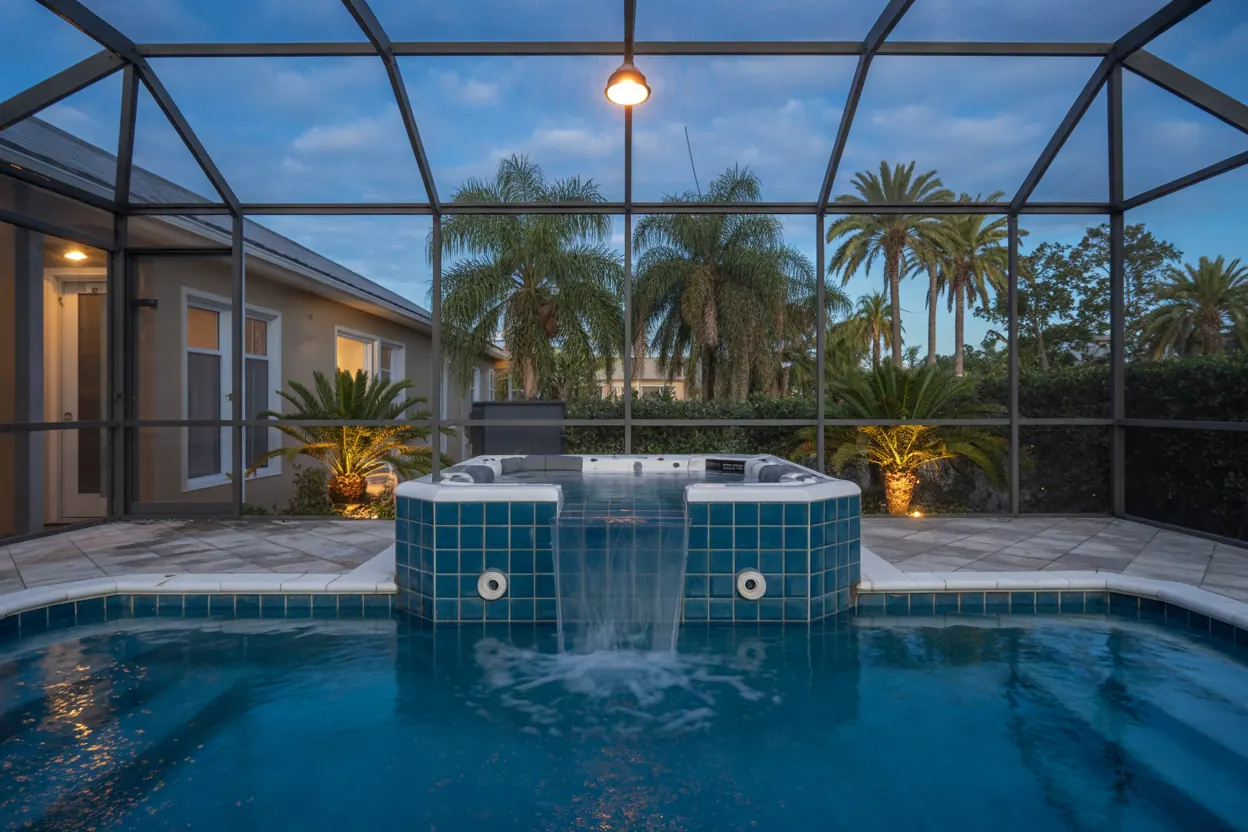
Florida: 617 pool builders and 7 specialists confirm this work on their own websites — 408 state-licensed (DBPR). Grouped by city below.
A spa spilling into the pool, or a "spool" sized and heated like a spa, is one of the most common Florida add-ons. These builders describe spa or spool construction on their websites. Ask whether the spa shares the pool’s equipment, which affects heating cost and maintenance.
The featured spot here is open — one business only. A Service Page Featured Placement.
Put your company at the top of the Pool & Spa Combos and Spools page, statewidePalm Bay (2) · Englewood (2) · Maitland (2) · Land O' Lakes (2) · DeLand (2) · Boynton Beach (2) · Lithia (2) · Plantation (2) · Brooksville (2) · Margate (2) · Wellington (2) · Hernando (2) · North Lauderdale (2) · Pembroke Pines (2) · Key West (2) · Lake Wales (2) · Ponte Vedra Beach (2) · Destin (2) · Seminole (2) · Weston (2) · Deerfield Beach (2) · Coconut Creek (1) · Vernon (1) · Fort Walton Beach (1) · Doral (1) · North Fort Myers (1) · Royal Palm Beach (1) · Valrico (1) · Live Oak (1) · Odessa (1) · Sebastian (1) · Dunedin (1) · Okeechobee (1) · Lakewood Ranch (1) · Yulee (1) · Islamorada (1)
That is a personal decision this directory cannot make. The case for a pool in Florida is stronger than almost anywhere else in the country: a swim season that runs from March into November unheated in most of the state, and year-round with a heat pump. The costs are ongoing: electricity for the pump, chemicals that burn off fast in sun, water to replace evaporation, periodic resurfacing, screen re-screening after storms and equipment replacement. There are responsibilities too. Chapter 515 of the Florida Statutes requires a safety feature on every new pool because drowning is the leading cause of unintentional death for Florida children ages 1 to 4, insurance may rise, and summer water can get too warm to refresh without shade. Alternatives include a spool or plunge pool on a small lot, a cocktail pool under an existing lanai, a community pool membership, or a screened patio with fans. Homeowners who swim often and keep up maintenance tend to be happy. Those who want the look without the use often find it a chore.
Yes. Florida licenses swimming pool contractors statewide under Chapter 489, Part I, of the Florida Statutes, administered by the Department of Business and Professional Regulation (DBPR) and the Construction Industry Licensing Board. Section 489.105 defines three pool categories: commercial pool/spa contractor, residential pool/spa contractor and swimming pool/spa servicing contractor. Building, repairing or servicing a pool for compensation without one of these licenses is unlicensed contracting under section 489.127. The crew does not all need licenses: section 489.117(4)(e) lets unlicensed workers do pool work under the supervision and responsibility of a licensed pool contractor, but not the plumbing or electrical. To become certified, an applicant passes the state contractor examination, documents experience, shows financial responsibility with a credit report, and files proof of liability insurance and workers' compensation coverage or exemption under section 489.115. Registered contractors instead qualify with a county or city competency license and then register with the state. A builder's license number should appear on the contract, the permit and the truck, as of November 2026.
Chapter 515 of the Florida Statutes, the Preston de Ibern/McKenzie Merriam Residential Swimming Pool Safety Act, applies to every new residential pool, spa or hot tub deeper than 24 inches. Section 515.27 says the pool cannot pass final inspection unless it has at least one of five features: a barrier meeting section 515.29 that isolates the pool from the house; an approved safety cover meeting ASTM F1346; exit alarms on every door and window that opens to the pool, rated at least 85 decibels at 10 feet; self-closing, self-latching devices on those doors with the release at least 54 inches above the floor; or a pool alarm certified to ASTM F2208 that sounds when someone enters the water (wearable child alarms do not count). The fifth option, the pool alarm, was added in 2016, so older handouts list four. A screen enclosure counts as the barrier when it meets the code's climbing rules. The penalty for a new pool without a feature is a second-degree misdemeanor, waived if the owner installs one and attends a drowning prevention course within 45 days. Section 515.33 requires pool contractors to hand buyers a summary of the law. Many counties go further and require a 360-degree barrier regardless of which option is chosen, as of November 2026.
Two layers apply. The federal Virginia Graeme Baker Pool and Spa Safety Act, enforced by the Consumer Product Safety Commission under 16 CFR Part 1450, requires every drain cover manufactured or sold in the United States to meet the anti-entrapment standard, currently ANSI/APSP/ICC-16 as the successor to ASME A112.19.8. The Act's secondary-device requirement, such as a safety vacuum release system or a second drain, is mandatory for public pools; for a home pool the standard arrives through the building code. Section R4501.6 of the Florida Building Code, Residential, requires suction outlets and the suction system to follow ANSI/APSP/ICC-7 and limits suction piping velocity, which in practice means a compliant cover, dual drains or an unblockable drain and a design the plan reviewer checks. Jacksonville, Sarasota and Lee County all ask for the drain cover data sheet or a suction outlet compliance form with the permit. Owners of older pools should know that a flat, cracked or missing drain cover is the single most dangerous defect a pool inspector finds, and that replacing it is a job for a licensed pool contractor or servicing contractor.
A pool and spa combo is a pool with an attached spa that shares the shell, plumbing and equipment, usually with a spillway between them. The spa needs a heater and its own jet pump, and the equipment pad is sized for both. A spool is a spa-sized pool, often with jets and a heater, built for soaking and cooling off rather than swimming; it fits the small lots common in Florida's newer subdivisions and under an existing lanai cage. This directory does not publish combo prices. The cost drivers are the extra shell area, the heater or heat pump, the jet system and the controls. In Florida a gas heater needs a licensed plumber or gas contractor for the line and the electrical work needs a licensed electrical contractor; the pool contractor's scope under section 489.105 stops at those connections. A spa or spool is a "swimming pool" under Chapter 515 whenever it holds more than 24 inches of water, so the same safety-feature rules apply, and a lockable safety cover meeting ASTM F1346 is one way to satisfy them. Portable spas that meet the standard are exempt.
An unheated Florida pool is comfortable for most people from about April to October in the central and southern parts of the state, and shorter in the Panhandle and north. Most swimmers call water below the high 70s cold and the low to mid 80s comfortable; lap swimmers like it cooler. A heat pump, which pulls heat from the air, is the common choice for extending the season because it runs efficiently in Florida's mild winters; a gas heater heats faster and suits a spa; solar panels on a roof are cheap to run but slow. A solar cover does make a pool warmer by stopping evaporation, the main heat loss, and a plain tarp helps less. The opposite problem arrives in July, when an uncaged pool in full sun can pass 90 degrees. Options are evaporation at night from a fountain or aerator, shade from a cage or sail, a lighter interior finish, and a heat pump with a chiller mode, which is the only method that works in Florida's humidity. Builders can plumb for a heater or chiller during construction so it can be added later without opening the deck. This directory does not quote equipment prices.