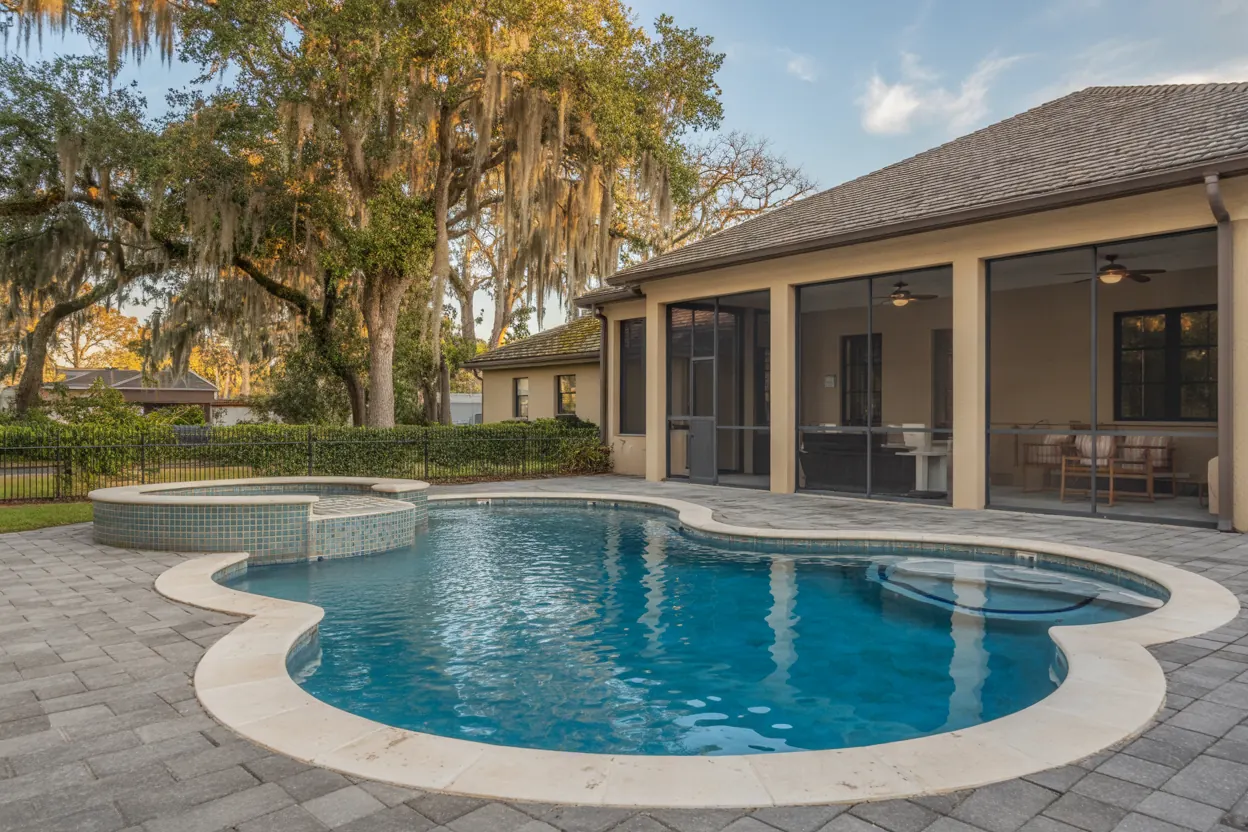
Florida pool questions, answered
These are the questions people type into Google before hiring a pool builder in Florida, answered from primary sources where one exists. No prices are quoted unless a source is cited; the drivers are explained instead.
How much does it cost to build a pool in Florida?
This directory does not publish price tables. Pool pricing in Florida moves with material costs, labor demand, the county and the yard, so any single number would go stale fast. What the editor can say is what sets the price. The shell type (gunite, fiberglass or vinyl) sets the base. Size and depth add excavation, steel and finish. Interior finish, tile, paver or concrete decking, equipment and water features each add a line. Florida adds items that buyers from other states do not expect: a screen enclosure, which most new pools here get; a heater or heat pump for the cooler months; and dewatering, because the water table in much of the state sits close to the surface and the hole must be pumped dry while the shell is built. Coastal and flood-zone lots can need extra engineering. The clearest way to learn current pricing is to collect three written bids for the same design in the same month.
What size pool is right for a Florida backyard or a family?
Most Florida backyard pools fall between a small plunge pool and a 20 by 40 foot family pool, and many are smaller than pools in states with bigger lots. Bigger pools cost more to build, heat, fill and chemically treat, because every cost scales with surface area and volume, and in Florida the screen enclosure scales with the deck around it. Many families find that a pool in the 12 by 24 to 15 by 30 range gives room to swim and play without taking the whole yard. A 20 by 40 pool suits lap swimming or large groups but needs a large lot and a large cage. Setbacks limit the footprint; counties and cities set their own numbers, and lakefront and canal lots often carry extra setbacks from the water. This directory does not quote prices by size. A builder can lay out options on a survey before any price is set.
How long should a pool pump run in Florida, and what does the electricity cost?
The pump is the main electrical load on a residential pool. A single-speed pump running long hours in a Florida summer uses far more energy than a variable-speed pump turning the same water over at low speed, and the Florida Building Code's energy provisions now steer new pools toward variable-speed equipment. Pumps do not need to run all day. The goal is to filter the full pool volume at least once daily, which most owners reach with longer summer and shorter winter run times. For scale, FPL's residential rate card effective October 2026 lists a base energy charge of 7.865 cents per kWh for the first 1,000 kWh plus a fuel charge of 2.893 cents per kWh and smaller riders, and Tampa Electric's January 2026 insert lists 9.569 cents energy plus 3.210 cents fuel for the first 1,000 kWh. Usage above 1,000 kWh is billed at a higher tier with both utilities, and a pool pump can push a household over that line. The editor does not estimate a pool's monthly cost here because run time, pump size and tier vary by home. A builder or service company can set a schedule for a specific pump.
Does a pool add value to a home in Florida?
This directory does not publish value statistics, and the editor has not found a reliable Florida-wide figure. What is known is that pools are common in most Florida metro areas, so a pool rarely puts off local buyers the way it might in a colder state, and in some neighborhoods buyers expect one. A pool almost never returns its full construction cost at sale. Condition matters more than presence. A clean pool with current equipment, a sound screen enclosure and a compliant barrier is a selling point. A stained, leaking or unscreened pool, or a cage with corroded fasteners and torn panels, is a negotiation item. Florida sellers must disclose known material defects that are not readily observable, and a leaking shell or a failed heater is the kind of thing that comes up at inspection. Anyone planning a pool for resale alone should talk to a local agent first; anyone planning one to swim in should build the one they will use.
Does adding a pool increase property taxes in Florida?
Usually yes. Florida's Save Our Homes cap, in section 193.155 of the Florida Statutes, limits the yearly increase in a homestead's assessed value to the lower of 3 percent or the change in the consumer price index. But subsection (4) says changes, additions or improvements to homestead property are assessed at just value as of the first January 1 after they are substantially completed. A new pool is such an improvement, so its market value is added on top of the cap in that first year, and the Hillsborough County Property Appraiser explains that the added value then rides under the cap in later years. How much the assessment rises depends on the appraiser's method and the pool's size, enclosure and features. Homeowners do not stop paying property tax at 65 in Florida; section 196.075 lets a county or city offer an additional exemption to residents 65 and older whose household income falls under an indexed limit, and a separate exemption for long-term residents of low-value homes. This directory does not rank counties by tax rate. The county property appraiser can estimate the change for a specific home.
Does a pool raise homeowners insurance in Florida?
Usually yes, though the amount varies by insurer, and in Florida the pool is a small line next to the wind and roof questions that drive premiums. A pool adds liability exposure, so carriers often recommend or require higher liability limits and may ask about the barrier, a diving board or a slide. Some insurers require a compliant fence or screen enclosure and self-latching gate before covering a pool at all. The pool structure itself is often covered as an "other structure" with its own limit, which can be too low for a replacement, and the screen enclosure is the part most often damaged in a hurricane. Many Florida policies limit or exclude screen enclosure coverage unless it is added by endorsement, and wind claims carry a separate hurricane deductible. This directory cannot quote premiums. Homeowners should call their agent before construction starts, ask what the policy requires for the barrier, and ask specifically how the cage is covered. The other-structures limit should be updated once the pool is finished.
Can a swimming pool be written off on taxes?
This directory does not give tax advice. In general, a residential pool is a personal expense and is not deductible. IRS Publication 502 allows some capital improvements as medical expenses when their main purpose is medical care for the taxpayer, a spouse or a dependent, and even then only the part of the cost that exceeds any increase in the home's value counts, and only medical expenses above 7.5 percent of adjusted gross income are deductible. The publication does not name swimming pools, and a doctor's note alone does not make a pool qualify. A pool does count as a capital improvement that raises the home's cost basis, which can matter at sale. Florida has no state income tax, so the question is federal only. The editor did not research senior income-tax deductions for this directory, since they have nothing to do with pools. Property tax is a separate matter handled by the county property appraiser. For any of these questions, a licensed tax professional should review the specific facts.
Is a pool worth it in Florida, and what are the alternatives?
That is a personal decision this directory cannot make. The case for a pool in Florida is stronger than almost anywhere else in the country: a swim season that runs from March into November unheated in most of the state, and year-round with a heat pump. The costs are ongoing: electricity for the pump, chemicals that burn off fast in sun, water to replace evaporation, periodic resurfacing, screen re-screening after storms and equipment replacement. There are responsibilities too. Chapter 515 of the Florida Statutes requires a safety feature on every new pool because drowning is the leading cause of unintentional death for Florida children ages 1 to 4, insurance may rise, and summer water can get too warm to refresh without shade. Alternatives include a spool or plunge pool on a small lot, a cocktail pool under an existing lanai, a community pool membership, or a screened patio with fans. Homeowners who swim often and keep up maintenance tend to be happy. Those who want the look without the use often find it a chore.
Do pool contractors need to be licensed in Florida, and how do they get the license?
Yes. Florida licenses swimming pool contractors statewide under Chapter 489, Part I, of the Florida Statutes, administered by the Department of Business and Professional Regulation (DBPR) and the Construction Industry Licensing Board. Section 489.105 defines three pool categories: commercial pool/spa contractor, residential pool/spa contractor and swimming pool/spa servicing contractor. Building, repairing or servicing a pool for compensation without one of these licenses is unlicensed contracting under section 489.127. The crew does not all need licenses: section 489.117(4)(e) lets unlicensed workers do pool work under the supervision and responsibility of a licensed pool contractor, but not the plumbing or electrical. To become certified, an applicant passes the state contractor examination, documents experience, shows financial responsibility with a credit report, and files proof of liability insurance and workers' compensation coverage or exemption under section 489.115. Registered contractors instead qualify with a county or city competency license and then register with the state. A builder's license number should appear on the contract, the permit and the truck, as of November 2026.
What does the Florida Residential Swimming Pool Safety Act require?
Chapter 515 of the Florida Statutes, the Preston de Ibern/McKenzie Merriam Residential Swimming Pool Safety Act, applies to every new residential pool, spa or hot tub deeper than 24 inches. Section 515.27 says the pool cannot pass final inspection unless it has at least one of five features: a barrier meeting section 515.29 that isolates the pool from the house; an approved safety cover meeting ASTM F1346; exit alarms on every door and window that opens to the pool, rated at least 85 decibels at 10 feet; self-closing, self-latching devices on those doors with the release at least 54 inches above the floor; or a pool alarm certified to ASTM F2208 that sounds when someone enters the water (wearable child alarms do not count). The fifth option, the pool alarm, was added in 2016, so older handouts list four. A screen enclosure counts as the barrier when it meets the code's climbing rules. The penalty for a new pool without a feature is a second-degree misdemeanor, waived if the owner installs one and attends a drowning prevention course within 45 days. Section 515.33 requires pool contractors to hand buyers a summary of the law. Many counties go further and require a 360-degree barrier regardless of which option is chosen, as of November 2026.
What does a Florida residential pool barrier or fence have to look like?
Section 515.29 of the Florida Statutes sets the frame and Section R4501.17 of the Florida Building Code, Residential, fills in the numbers. The barrier must be at least 4 feet (48 inches) high measured on the outside, with no gaps, openings or footholds that would let a young child crawl under, squeeze through or climb over; the code bars any opening that passes a 4-inch sphere. Gates must open outward away from the pool, self-close and self-latch, with the release on the pool side where a small child cannot reach it. The barrier must stand far enough from the water that a child who gets through does not fall straight in; the code puts the minimum at 20 inches from the pool edge. A dwelling wall can form part of the barrier only if no door or window opens through it to the pool, or if those openings are alarmed or self-closing under the Chapter 515 options. Nothing climbable, such as equipment, furniture or a planter, may sit against the outside. Miami-Dade County requires a permanent barrier on every pool under its own code. The editor could not identify any "25-foot law" for Florida residential pools; the number does not appear in Chapter 515 or the code's barrier section, as of November 2026.
Does a screen enclosure count as a pool barrier in Florida?
Yes, with conditions. Section R4501.17.1.11 of the Florida Building Code, Residential, allows a screen enclosure to serve as the required barrier when it meets the climbing requirements that apply to any barrier: 48 inches high, no gaps that pass a 4-inch sphere, and screen doors that self-close and self-latch with the latch out of a small child's reach. Miami-Dade County lists a screened-in patio among acceptable permanent barriers. The catch is the house. A cage attached to the home does not isolate the pool from the house, so every door and low window that opens from the home into the enclosure needs one of the Chapter 515 measures, usually an exit alarm meeting UL 2017 or a self-closing, self-latching device with the release 54 inches up, or the pool itself needs an ASTM F2208 alarm. Inspectors check this at the barrier inspection before the pool is filled. Re-screening and door hardware matter for safety as well as bugs: a sagging door that no longer latches turns a compliant barrier into a non-compliant one. Owners who want the pool isolated from the house without alarms add a removable mesh fence inside the cage.
What are the drain cover and suction entrapment rules for a new Florida pool?
Two layers apply. The federal Virginia Graeme Baker Pool and Spa Safety Act, enforced by the Consumer Product Safety Commission under 16 CFR Part 1450, requires every drain cover manufactured or sold in the United States to meet the anti-entrapment standard, currently ANSI/APSP/ICC-16 as the successor to ASME A112.19.8. The Act's secondary-device requirement, such as a safety vacuum release system or a second drain, is mandatory for public pools; for a home pool the standard arrives through the building code. Section R4501.6 of the Florida Building Code, Residential, requires suction outlets and the suction system to follow ANSI/APSP/ICC-7 and limits suction piping velocity, which in practice means a compliant cover, dual drains or an unblockable drain and a design the plan reviewer checks. Jacksonville, Sarasota and Lee County all ask for the drain cover data sheet or a suction outlet compliance form with the permit. Owners of older pools should know that a flat, cracked or missing drain cover is the single most dangerous defect a pool inspector finds, and that replacing it is a job for a licensed pool contractor or servicing contractor.
Do I need HOA approval to build a pool in Florida?
If the home is in a community governed by Chapter 720 of the Florida Statutes with an architectural review committee, that approval usually comes before the county permit, and many Florida permit checklists ask for the HOA letter. Section 720.3035 says the committee's authority must come from the declaration or published guidelines, must be applied uniformly, and if a request is denied the association must give written notice that identifies the specific rule and the specific part of the plan that fails it. Where the documents offer a choice of materials or locations, the owner may choose among them. Typical pool rules cover setbacks from fences, equipment placement and screening, cage height and color, fence style, drainage and construction hours. Builders often need to remove a fence section for excavation equipment, which may require sign-off and a repair commitment. The contract should state who prepares the HOA submittal. An association that knowingly and unreasonably infringes an owner's rights under its own documents can be liable for damages and fees, but a fight with the HOA is slower than a permit, so start it first and get the approval in writing before scheduling the dig.
What are Class A, B and C pools in Florida, and do those rules apply to a backyard pool?
Those classes come from Florida's public pool rules, not from residential law. Chapter 514 of the Florida Statutes puts public swimming pools under the Department of Health, and section 514.011 defines a public pool to include pools serving hotels, apartments, condominiums, mobile home parks, subdivisions, schools, camps and any cooperative housing of five or more units. The Department's rule chapter 64E-9 historically sorted those pools into classes by use, with Class A for competition pools, Class B for public pools open to the general public and Class C for pools serving condominiums, apartments and similar private communities, each with its own operating and signage rules. The editor could not open a current copy of the class definitions and notes that the Department has been revising the rule, so the class labels should be confirmed with the county health department before relying on them. None of this applies to a backyard pool. Section 514.011 defines a private pool as one used by a single family or living unit and its guests, and that pool answers to Chapter 515, the Florida Building Code and the county building department instead. An HOA community pool is public under Chapter 514 even if the gate is locked.
How long does it take to build a pool in Florida?
Build time depends on the shell type, the county's permit queue, the weather, the enclosure and the builder's schedule. A fiberglass pool can be set in days once the shell arrives, but the factory order and delivery add weeks. A gunite pool moves through layout, excavation and dewatering, steel, plumbing, shotcrete, tile and coping, decking, the screen enclosure, plaster and start-up, each by a different crew, with curing and inspections between steps. Permits come first; section 553.792 gives a local government up to 30 business days to act on a complete residential application. The summer rainy season slows excavation and shotcrete, and hurricane season from June 1 to November 30 can halt coastal jobs for a week at a time. After the 2022 and 2024 storms, Southwest Florida builders and screen companies reported long backlogs, and the editor cannot say when a given county's queue will be normal. The enclosure is frequently the last item and often runs on a separate contractor's calendar. Homeowners should ask each builder for a written schedule with milestones, and ask separately when the cage will be done, rather than accepting a single finish date.
What is the best time of year to build a pool in Florida?
Fall and winter are the preferred build windows in most of Florida. The dry season runs roughly from late October to May, which means fewer rain delays on excavation, dewatering and shotcrete, and plaster cures more evenly when it is not baking. A pool started in October or November is usually swimming by spring. Spring is the busiest season because many homeowners want a pool by summer, so schedules fill and lead times grow. Summer brings daily thunderstorms that stop crews in the afternoon, and Florida leads the nation in lightning, which halts outdoor work on its own. The Atlantic hurricane season runs June 1 through November 30, and a named storm can shut down a coastal job and divert screen crews to repairs for months afterward. Some builders offer off-season incentives, but this directory cannot verify pricing claims. One more Florida note: the water table is highest at the end of the rainy season, which makes a late-summer dig the wettest and most expensive one of the year on low lots.
How long does an inground pool last in Florida?
The shell and the finish have different lives. A well-built gunite or shotcrete shell can last for many decades, and Florida pools from the 1960s and 1970s are still in service after remodels. The interior finish is a wear item and is replaced several times over the shell's life, and Florida's twelve-month season, heavy sun and high chemical demand wear a finish faster than a seasonal climate does. Fiberglass shells are also long-lived, with the gelcoat surface being the part that ages. Vinyl liners are replaced on a shorter cycle. Equipment such as pumps, filters, heaters and salt cells is replaced more often still, and screen enclosures need re-screening and fastener replacement on their own cycle, sooner near salt water. This directory does not publish year counts because they vary with chemistry, soil, groundwater and workmanship. The best predictors are an engineered shell with hydrostatic relief, consistent water balance, and never leaving the pool empty.
What is a pool and spa combo, and what is a spool?
A pool and spa combo is a pool with an attached spa that shares the shell, plumbing and equipment, usually with a spillway between them. The spa needs a heater and its own jet pump, and the equipment pad is sized for both. A spool is a spa-sized pool, often with jets and a heater, built for soaking and cooling off rather than swimming; it fits the small lots common in Florida's newer subdivisions and under an existing lanai cage. This directory does not publish combo prices. The cost drivers are the extra shell area, the heater or heat pump, the jet system and the controls. In Florida a gas heater needs a licensed plumber or gas contractor for the line and the electrical work needs a licensed electrical contractor; the pool contractor's scope under section 489.105 stops at those connections. A spa or spool is a "swimming pool" under Chapter 515 whenever it holds more than 24 inches of water, so the same safety-feature rules apply, and a lockable safety cover meeting ASTM F1346 is one way to satisfy them. Portable spas that meet the standard are exempt.
Is a saltwater pool or a chlorine pool better in Florida?
A saltwater pool is still a chlorine pool. A salt cell generates chlorine from dissolved salt instead of the owner adding it. Owners like the softer feel and steadier sanitizer level, and salt systems are the default on most new Florida builds. The trade-offs here are specific. Salt cells work harder in warm water and need regular cleaning for calcium scale, which forms fast in Florida's hard water. Salt water attacks some natural stone coping, travertine sealers, aluminum screen-cage fasteners and nearby lawn when the pool is backwashed or splashed, so material choices matter at design time. A conventional chlorine pool costs less upfront and is simpler to repair. Shock is a high dose of chlorine or a non-chlorine oxidizer, not a different sanitizer. Household bleach is sodium hypochlorite at a lower strength than pool liquid chlorine. Both systems depend on balanced pH and a stabilizer level matched to Florida sun, which strips unstabilized chlorine within hours. Dosing questions belong with a pool service professional who can see the test results.
Why do Florida pools have screen enclosures, and who can build a pool cage?
Mosquitoes, no-see-ums, love bugs, oak pollen, palm fronds, frogs and the sun. A screened pool enclosure, called a pool cage, lanai or birdcage depending on the county, keeps most of that out, cuts the daily skimming and chemical load, and provides shade. It also doubles as the pool barrier under the Florida Building Code when its doors self-close and self-latch. The downsides are real: a cage blocks some sun and sky, panels tear and fasteners corrode near salt water, and the structure is the first thing damaged in a hurricane and often the last thing repaired. A sunroom is a conditioned room with a solid roof and glass; it needs a different permit and much more money. This directory does not publish enclosure prices; the drivers are footprint, height, roof style (flat, gable or mansard), screen grade and the engineered wind load for the site. A new cage or a re-roofed one needs a building permit with signed and sealed engineering. The builder should be a Certified Specialty Structure Contractor, whose scope under Rule 61G4-15.015 covers screen enclosures and pool enclosures, or a licensed general, building or residential contractor. Mosquitoes get in through torn panels and gaps under doors, not through sound screen; WD-40 is not a pest control product and the editor found no source supporting it.
Do you need a pool heater in Florida, and how do you keep a pool cool in summer?
An unheated Florida pool is comfortable for most people from about April to October in the central and southern parts of the state, and shorter in the Panhandle and north. Most swimmers call water below the high 70s cold and the low to mid 80s comfortable; lap swimmers like it cooler. A heat pump, which pulls heat from the air, is the common choice for extending the season because it runs efficiently in Florida's mild winters; a gas heater heats faster and suits a spa; solar panels on a roof are cheap to run but slow. A solar cover does make a pool warmer by stopping evaporation, the main heat loss, and a plain tarp helps less. The opposite problem arrives in July, when an uncaged pool in full sun can pass 90 degrees. Options are evaporation at night from a fountain or aerator, shade from a cage or sail, a lighter interior finish, and a heat pump with a chiller mode, which is the only method that works in Florida's humidity. Builders can plumb for a heater or chiller during construction so it can be added later without opening the deck. This directory does not quote equipment prices.
How do I prepare a pool for a hurricane in Florida?
Do not drain it. UF/IFAS Extension's advice is to keep the pool full: a full shell resists the groundwater and surge that a storm brings, and a drained or partly drained pool can crack or float when the saturated yard pushes on it. Before the storm, shock the water, clear and secure furniture, toys and umbrellas, and do not throw them in the pool, where they corrode and stain the finish. Turn off power to the equipment at the breaker before the storm arrives if flooding is likely; if power stays on, running the pump keeps water moving. Do not remove screen panels from a cage; the structure is engineered to carry them, and local codes do not call for it. After the storm, wait until the area is safe and watch for downed lines, snakes and alligators. Remove debris before it stains, then lower the water to mid-skimmer, rebalance and shock again, and have any equipment that was under water inspected before restarting it. Do not refill with reclaimed water. The Atlantic season runs June 1 to November 30; Florida builders pause excavation and shotcrete when a storm is forecast, so expect schedule slips in late summer.
How much water does a Florida pool lose to evaporation, and is adding water every week normal?
Yes, topping off weekly is normal in Florida, especially in the dry season and in spring, when the air is warm and dry and the wind is up. Evaporation rises with water temperature, wind, low humidity and surface area, and falls under a screen cage, which cuts both sun and wind. Summer humidity slows evaporation but summer rain can overfill the pool instead. The editor could not find a state figure for backyard pools specifically, so this directory does not quote inches per week; a loss of a fraction of an inch a day in hot, dry, windy weather is within normal range, and more than that points to a leak. The bucket test is the standard check: set a bucket of water on a step, mark both levels, and compare after a day with the pump off. A cover is the most effective fix because it blocks the surface. In a drought year, several Florida water management districts and utilities restrict outdoor water use, and some limit pool filling, so check the local rules before a build and before a refill after resurfacing.
How dangerous is lightning for a Florida pool, and when is it safe to swim?
Florida is the lightning capital of North America, with about 1.2 million cloud-to-ground strikes a year and more per square mile than any other state, according to the Florida Division of Emergency Management, and it averages about seven lightning deaths a year, often the most in the nation. Strikes peak in the summer afternoons when pools are busiest. The rule from the Division and the National Weather Service is that if you can hear thunder you are close enough to be struck, so everyone leaves the water and goes into an enclosed building at the first thunder, not when rain starts; lightning can strike 10 miles from the storm. A screen cage is not shelter. The common practice at public pools, waiting 30 minutes after the last thunder before swimming, is a sensible standard at home. The pool's bonding grid, inspected during construction, is there to keep everything metal at the same voltage and protects against electrical faults, not against a direct strike. Pool equipment itself is vulnerable to surges; a surge protector on the pump and heat pump circuits is a modest cost that Florida owners often add after their first summer.
How do I find and vet a good pool builder in Florida?
This directory does not rank builders and does not name a best one. What it can do is show the checks that matter in a state with a real license. Look up the company at myfloridalicense.com and confirm a current CPC or RP pool contractor license with the residential or commercial subcode, held by the entity on the contract. Read the DBPR record for discipline. Ask for a certificate of insurance sent by the insurer and ask whether the field crew is covered by workers' compensation or exempt. Check the county clerk's civil records and the Better Business Bureau for patterns. Visit a job in progress and call three recent references, one of them at least a year old so you hear about warranty service. Ask who builds the screen enclosure and whether that company is a licensed specialty structure contractor. Collect three written bids for the same design and compare the base price and the options list separately. Keep your top budget to yourself until bids are in. Be cautious with builders who push a large deposit, refuse a written schedule or cannot explain the permit process in your county, as of November 2026.