Scott's Pools & Spas
595 Ashcroft Landing Dr, Jacksonville 32225
State-licensed · DBPR #CPC1460880 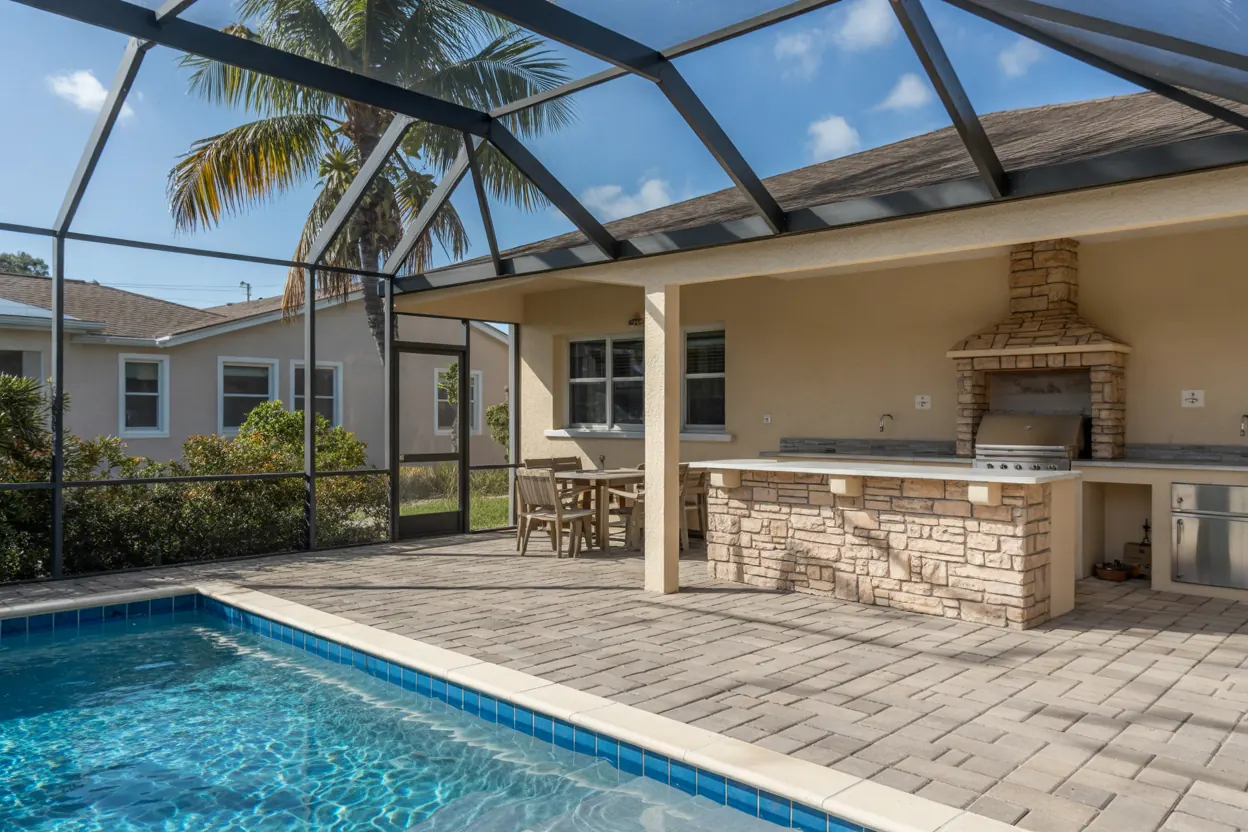
Florida: 469 pool builders and 12 specialists confirm this work on their own websites — 295 state-licensed (DBPR). Grouped by city below.
In Florida the pool is rarely sold alone: screen enclosures, lanais, paver decks, outdoor kitchens and summer kitchens come with it. These builders describe outdoor living work alongside the pool. Ask whether the builder self-performs the enclosure and hardscape or subcontracts it, and who warrants what.
The featured spot here is open — one business only. A Service Page Featured Placement.
Put your company at the top of the Pool Builders Who Do Outdoor Living page, statewideLake City (2) · Gainesville (2) · Pace (2) · Sebastian (2) · Coconut Creek (2) · Altamonte Springs (2) · Lecanto (2) · Lithia (2) · New Port Richey (2) · Winter Park (2) · Doral (2) · Orange Park (2) · Key West (2) · Margate (2) · Wellington (2) · Marco Island (2) · Fort Pierce (2) · Lake Wales (2) · Orange City (2) · Port Orange (2) · Ponte Vedra Beach (2) · Lantana (2) · Miramar (2) · St Cloud (2) · Seminole (2) · Palm Bay (1) · Homosassa (1) · Vernon (1) · Palm Coast (1) · Fort Walton Beach (1) · DeLand (1) · North Fort Myers (1) · Royal Palm Beach (1) · Green Cove Springs (1) · Hernando (1) · Sunrise (1) · Live Oak (1) · Maitland (1) · Dunedin (1) · Sebring (1) · Lakewood Ranch (1) · Kissimmee (1) · Merritt Island (1) · Land O' Lakes (1) · Destin (1) · Yulee (1) · Starke (1) · Lehigh Acres (1) · Brooksville (1) · Islamorada (1) · New Smyrna Beach (1) · Valrico (1)
This directory does not publish price tables. Pool pricing in Florida moves with material costs, labor demand, the county and the yard, so any single number would go stale fast. What the editor can say is what sets the price. The shell type (gunite, fiberglass or vinyl) sets the base. Size and depth add excavation, steel and finish. Interior finish, tile, paver or concrete decking, equipment and water features each add a line. Florida adds items that buyers from other states do not expect: a screen enclosure, which most new pools here get; a heater or heat pump for the cooler months; and dewatering, because the water table in much of the state sits close to the surface and the hole must be pumped dry while the shell is built. Coastal and flood-zone lots can need extra engineering. The clearest way to learn current pricing is to collect three written bids for the same design in the same month.
Most Florida backyard pools fall between a small plunge pool and a 20 by 40 foot family pool, and many are smaller than pools in states with bigger lots. Bigger pools cost more to build, heat, fill and chemically treat, because every cost scales with surface area and volume, and in Florida the screen enclosure scales with the deck around it. Many families find that a pool in the 12 by 24 to 15 by 30 range gives room to swim and play without taking the whole yard. A 20 by 40 pool suits lap swimming or large groups but needs a large lot and a large cage. Setbacks limit the footprint; counties and cities set their own numbers, and lakefront and canal lots often carry extra setbacks from the water. This directory does not quote prices by size. A builder can lay out options on a survey before any price is set.
This directory does not publish value statistics, and the editor has not found a reliable Florida-wide figure. What is known is that pools are common in most Florida metro areas, so a pool rarely puts off local buyers the way it might in a colder state, and in some neighborhoods buyers expect one. A pool almost never returns its full construction cost at sale. Condition matters more than presence. A clean pool with current equipment, a sound screen enclosure and a compliant barrier is a selling point. A stained, leaking or unscreened pool, or a cage with corroded fasteners and torn panels, is a negotiation item. Florida sellers must disclose known material defects that are not readily observable, and a leaking shell or a failed heater is the kind of thing that comes up at inspection. Anyone planning a pool for resale alone should talk to a local agent first; anyone planning one to swim in should build the one they will use.
Usually yes. Florida's Save Our Homes cap, in section 193.155 of the Florida Statutes, limits the yearly increase in a homestead's assessed value to the lower of 3 percent or the change in the consumer price index. But subsection (4) says changes, additions or improvements to homestead property are assessed at just value as of the first January 1 after they are substantially completed. A new pool is such an improvement, so its market value is added on top of the cap in that first year, and the Hillsborough County Property Appraiser explains that the added value then rides under the cap in later years. How much the assessment rises depends on the appraiser's method and the pool's size, enclosure and features. Homeowners do not stop paying property tax at 65 in Florida; section 196.075 lets a county or city offer an additional exemption to residents 65 and older whose household income falls under an indexed limit, and a separate exemption for long-term residents of low-value homes. This directory does not rank counties by tax rate. The county property appraiser can estimate the change for a specific home.
Usually yes, though the amount varies by insurer, and in Florida the pool is a small line next to the wind and roof questions that drive premiums. A pool adds liability exposure, so carriers often recommend or require higher liability limits and may ask about the barrier, a diving board or a slide. Some insurers require a compliant fence or screen enclosure and self-latching gate before covering a pool at all. The pool structure itself is often covered as an "other structure" with its own limit, which can be too low for a replacement, and the screen enclosure is the part most often damaged in a hurricane. Many Florida policies limit or exclude screen enclosure coverage unless it is added by endorsement, and wind claims carry a separate hurricane deductible. This directory cannot quote premiums. Homeowners should call their agent before construction starts, ask what the policy requires for the barrier, and ask specifically how the cage is covered. The other-structures limit should be updated once the pool is finished.
That is a personal decision this directory cannot make. The case for a pool in Florida is stronger than almost anywhere else in the country: a swim season that runs from March into November unheated in most of the state, and year-round with a heat pump. The costs are ongoing: electricity for the pump, chemicals that burn off fast in sun, water to replace evaporation, periodic resurfacing, screen re-screening after storms and equipment replacement. There are responsibilities too. Chapter 515 of the Florida Statutes requires a safety feature on every new pool because drowning is the leading cause of unintentional death for Florida children ages 1 to 4, insurance may rise, and summer water can get too warm to refresh without shade. Alternatives include a spool or plunge pool on a small lot, a cocktail pool under an existing lanai, a community pool membership, or a screened patio with fans. Homeowners who swim often and keep up maintenance tend to be happy. Those who want the look without the use often find it a chore.
Chapter 515 of the Florida Statutes, the Preston de Ibern/McKenzie Merriam Residential Swimming Pool Safety Act, applies to every new residential pool, spa or hot tub deeper than 24 inches. Section 515.27 says the pool cannot pass final inspection unless it has at least one of five features: a barrier meeting section 515.29 that isolates the pool from the house; an approved safety cover meeting ASTM F1346; exit alarms on every door and window that opens to the pool, rated at least 85 decibels at 10 feet; self-closing, self-latching devices on those doors with the release at least 54 inches above the floor; or a pool alarm certified to ASTM F2208 that sounds when someone enters the water (wearable child alarms do not count). The fifth option, the pool alarm, was added in 2016, so older handouts list four. A screen enclosure counts as the barrier when it meets the code's climbing rules. The penalty for a new pool without a feature is a second-degree misdemeanor, waived if the owner installs one and attends a drowning prevention course within 45 days. Section 515.33 requires pool contractors to hand buyers a summary of the law. Many counties go further and require a 360-degree barrier regardless of which option is chosen, as of November 2026.
Yes, with conditions. Section R4501.17.1.11 of the Florida Building Code, Residential, allows a screen enclosure to serve as the required barrier when it meets the climbing requirements that apply to any barrier: 48 inches high, no gaps that pass a 4-inch sphere, and screen doors that self-close and self-latch with the latch out of a small child's reach. Miami-Dade County lists a screened-in patio among acceptable permanent barriers. The catch is the house. A cage attached to the home does not isolate the pool from the house, so every door and low window that opens from the home into the enclosure needs one of the Chapter 515 measures, usually an exit alarm meeting UL 2017 or a self-closing, self-latching device with the release 54 inches up, or the pool itself needs an ASTM F2208 alarm. Inspectors check this at the barrier inspection before the pool is filled. Re-screening and door hardware matter for safety as well as bugs: a sagging door that no longer latches turns a compliant barrier into a non-compliant one. Owners who want the pool isolated from the house without alarms add a removable mesh fence inside the cage.